
Introduction
Blockchain technology has transformed the way we think about security, transparency, and decentralization. But did you know that not all blockchains are the same? There are two main types: public and private blockchains. Understanding their differences is crucial, whether you’re an investor, a developer, or just curious about blockchain’s future.
In this guide, we will explore the key differences between public vs private blockchains, their benefits, real-world applications, and how to choose the right one for your needs.
What Are Blockchains?
A blockchain is a digital ledger that records transactions in a secure, immutable, and decentralized manner. It consists of blocks of data that are linked together, ensuring transparency and trust.
Imagine a notebook where every page contains a list of transactions. Once a page is full, it is locked forever, and a new page starts. Since every page is linked to the previous one, no one can go back and change the past.
Blockchains operate in two primary models:
- Public blockchains (open to anyone)
- Private blockchains (restricted access)
Public Blockchains: The Open Revolution
Characteristics of Public Blockchains
Public blockchains are completely decentralized and allow anyone to participate. They are designed to promote transparency and security.
Key characteristics:
- Decentralized: No single entity controls the network.
- Permissionless: Anyone can join and validate transactions.
- Highly Secure: Cryptographic protocols prevent fraud and hacking.
- Transparency: Transactions are visible to all participants.
Real-Life Examples of Public Blockchains
- Bitcoin (BTC): The first and most well-known public blockchain used for peer-to-peer digital transactions. Think of it like digital gold—people can send and receive Bitcoin without needing a bank.
- Ethereum (ETH): A blockchain that enables smart contracts and decentralized applications (DApps). Imagine a vending machine that releases a snack only if you insert the exact amount of money—Ethereum does something similar with smart contracts.
- Solana (SOL): A high-speed blockchain optimized for scalability and low transaction costs. It’s like a super-fast train that gets you where you need to go quickly and efficiently.
Pros and Cons of Public Blockchains
Pros:
- High transparency and security
- Fully decentralized with no central authority
- Greater user participation and network growth
Cons:
- Slower transaction speeds due to high traffic
- Higher energy consumption (especially in proof-of-work systems)
- Scalability challenges
Additional Real-World Use Cases of Public Blockchains
- Decentralized Finance (DeFi): Platforms like Uniswap allow users to trade cryptocurrencies without a middleman.
- Non-Fungible Tokens (NFTs): Digital collectibles like Bored Ape Yacht Club are traded on public blockchains.
- Supply Chain Transparency: Companies use public blockchains to verify the authenticity of products.
Private Blockchains: Controlled and Secure
Characteristics of Private Blockchains
Private blockchains are controlled by a single organization or a group of authorized users. They are commonly used by businesses for internal operations.
Key characteristics:
- Centralized control: A specific entity manages the network.
- Permissioned access: Only approved participants can join.
- Faster transactions: Fewer nodes lead to increased speed.
- Greater privacy: Data is not publicly accessible.
Real-Life Examples of Private Blockchains
- Hyperledger Fabric: Used by businesses for secure and permissioned transactions. Imagine a private library where only members can borrow books.
- R3 Corda: A blockchain platform for financial institutions. Think of it as a private WhatsApp group where only invited members can send messages.
- Quorum (by JPMorgan Now acquired by Consensys): A private Ethereum-based blockchain for banking and enterprise solutions. It’s like a VIP-only club where only certain people get access to special benefits.
Pros and Cons of Private Blockchains
Pros:
- High speed and scalability
- Lower energy consumption
- Enhanced privacy and security
Cons:
- Centralization reduces trust
- Less transparency
- Risk of manipulation by the controlling entity
Additional Real-World Use Cases of Private Blockchains
- Healthcare: Hospitals store patient records securely while ensuring that only authorized personnel can access them.
- Banking: Banks use private blockchains to settle transactions faster without relying on third-party services.
- Supply Chain Management: Walmart tracks food products to ensure they are safe and of high quality.
Key Differences Between Public and Private Blockchains
| Feature | Public Blockchain | Private Blockchain |
|---|---|---|
| Control | Decentralized | Centralized |
| Access | Open to all | Restricted |
| Speed | Slower | Faster |
| Security | Highly secure but slower | Secure but centralized |
| Transparency | Fully transparent | Limited transparency |
| Use Case | Cryptocurrencies, DeFi, NFTs | Banking, Supply Chain, Enterprise Applications |
Which One Should You Choose? Public or Private?
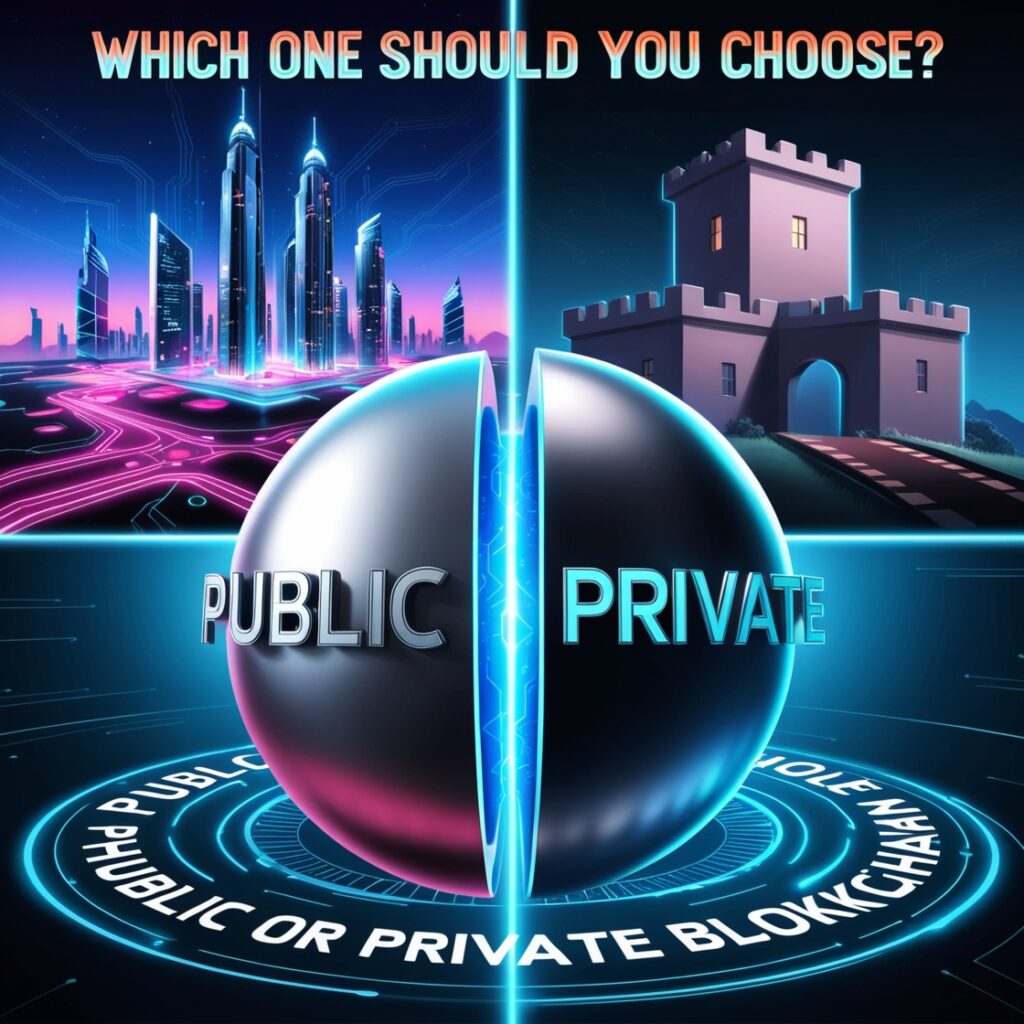
Choosing between public vs private blockchains depends on your needs:
- If you value decentralization, transparency, and openness, a public blockchain like Bitcoin or Ethereum is the best choice.
- If you need speed, privacy, and control, a private blockchain like Hyperledger Fabric or Quorum is more suitable.
When to Use Public Blockchains
- Cryptocurrencies and digital assets
- Decentralized finance (DeFi)
- Open-source applications
- Digital art and NFTs
When to Use Private Blockchains
- Corporate and enterprise applications
- Supply chain management
- Banking and financial services
- Government data storage
Conclusion and Call to Action
Blockchain technology is reshaping industries, but understanding public vs private blockchains is key to making the right choice. While public blockchains offer transparency and decentralization, private blockchains provide speed and security.
Think of it like choosing between a public park and a private garden. A public park is open to everyone, but sometimes it gets crowded. A private garden is peaceful and well-maintained, but only a few people can enter.
Are you ready to explore the world of blockchain further? Subscribe to our blog for the latest insights on crypto, DeFi, and blockchain innovations!