Cryptocurrency is changing the way we send and receive money, and the best part? No banks are needed! But if there are no banks to check if crypto transactions are real, how do we know they are legit? That’s what we’ll explore in this article—using super simple language and fun examples.
What Happens in a Normal Bank Transaction?
Before we dive into crypto, let’s first see how banks verify transactions. Imagine you buy a toy online and pay with your bank account. Here’s what happens:
- You send money – You enter your card details and press ‘Pay.’
- Bank verifies – The bank checks if you have enough money.
- Transaction gets approved – If everything is okay, the bank sends money to the seller.
- Bank records the transaction – The bank updates its system to show the payment.
Since banks control everything, they make sure transactions are real. But in crypto, there’s no bank! So, who checks if transactions are valid? Let’s find out.
How Are Crypto Transactions Verified Without Banks?
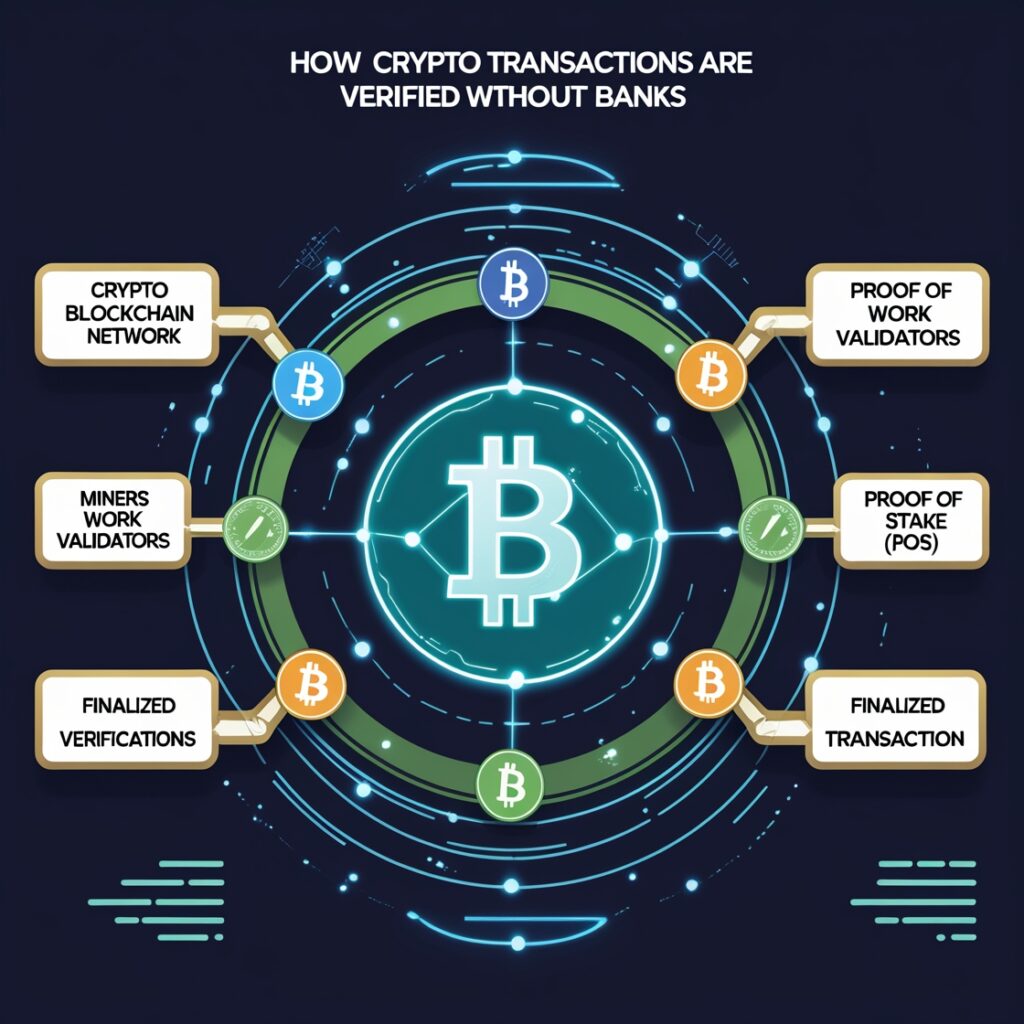
Cryptocurrency uses a technology called blockchain to verify transactions. Think of blockchain as a giant digital notebook where every transaction is recorded. But unlike a normal notebook, everyone can see it, and no one can erase past records. Here’s how it works step by step:
Step 1: You Make a Transaction
Let’s say you send 1 Bitcoin to your friend. When you do this, your transaction is sent to a network of computers.
Step 2: Miners or Validators Check the Transaction
Instead of a bank, crypto uses people called miners or validators to check transactions. These people use powerful computers to solve puzzles that confirm transactions.
Step 3: The Transaction Is Added to a Block
Once the transaction is verified, it is grouped with other transactions into a ‘block.’
Step 4: The Block Is Added to the Blockchain
After all transactions in a block are verified, the block is added to the blockchain. This means the transaction is now permanent and can’t be changed. We can check the transactions in any explorer for example for Ethereum we can check in etherscan.
Proof of Work vs. Proof of Stake – Two Ways to Verify Transactions
Crypto transactions are verified using different methods. The two most popular are:
1. Proof of Work (PoW) – Like Solving a Hard Puzzle
- Used by Bitcoin and some other cryptocurrencies.
- Miners compete to solve a complex math puzzle.
- The first miner to solve it gets to add the block to the blockchain.
- Miners get rewarded with new coins.
💡 Example: Imagine you and your friends are trying to solve a riddle. The first one to solve it gets a prize. In crypto, the winner adds the transaction to the blockchain and earns new coins.
2. Proof of Stake (PoS) – Like a Lucky Draw
- Used by Ethereum and other newer cryptos.
- Instead of solving puzzles, people who own more crypto get a higher chance to verify transactions.
- The chosen validator checks and adds the transaction.
- They get rewarded for their work.
💡 Example: Imagine putting your name in a hat for a lucky draw. The more tickets you have, the higher your chance of being chosen to check the transactions.
Other Ways Crypto Transactions Are Verified
While PoW and PoS are the most well-known, there are other methods used for transaction verification:
Delegated Proof of Stake (DPoS)
- Users vote for a small group of validators.
- These validators verify transactions and maintain the blockchain.
- Faster and more energy-efficient than PoW.
Proof of Authority (PoA)
- Used in private blockchains.
- Transactions are validated by approved and trusted entities.
- Common in enterprise blockchain solutions.
Zero-Knowledge Proofs (ZKP)
- A way to prove a transaction is valid without revealing details.
- Enhances privacy and security.
Why Is This System Secure?
You might be wondering: if no banks control crypto, can’t people cheat? The answer is no, because of blockchain security. Here’s why:
- Decentralization – Instead of one bank, thousands of computers check transactions. If one tries to cheat, the others will reject it.
- Immutability – Once a transaction is added to the blockchain, it can’t be changed or erased.
- Transparency – Everyone can see the transactions, so there’s no secret fraud.
- Incentives – Miners and validators get rewarded, so they have a reason to be honest.
Real-Life Example: Buying Coffee with Bitcoin
Let’s say you buy a coffee using Bitcoin. Here’s how it happens:
- You send Bitcoin to the coffee shop’s crypto wallet.
- The network verifies if you really have that Bitcoin.
- Miners/validators confirm the transaction.
- The coffee shop receives Bitcoin and gives you your coffee.
- The transaction is added to the blockchain forever.
Challenges and Limitations of Crypto Transaction Verification
Even though crypto verification is secure, it has some challenges:
- Energy Consumption – Proof of Work uses a lot of electricity.
- Transaction Speed – Some networks are slow during high activity.
- Scalability Issues – More transactions mean higher fees and congestion.
- 51% Attacks – If one group controls over 50% of mining power, they can manipulate transactions.
The Future of Crypto Transaction Verification
Many new solutions are being developed to improve verification:
- Layer 2 Solutions – Faster transactions using secondary networks like the Lightning Network.
- Sharding – Splitting the blockchain to process transactions in parallel.
- AI & Machine Learning – Improving security and fraud detection.
Final Thoughts: Why Crypto Transactions Are the Future
Crypto transactions work without banks because of blockchain technology and a network of computers verifying transactions. They are:
- Faster – No need to wait for bank approval.
- Cheaper – No middleman fees.
- Global – Send money anywhere, anytime.
- Secure – Almost impossible to hack.
As more people adopt crypto, understanding how transactions are verified will become even more important. Are you ready to explore more about the world of crypto? Stay tuned for our latest updates!