
Introduction: The Big Debate in Crypto
Imagine you have a magical wallet that lets you send money anywhere in the world without revealing your identity. Sounds cool, right? But what if bad guys use the same magic wallet for illegal activities? This is the great debate in the crypto world: should transactions be fully anonymous, or should users verify their identity (KYC – Know Your Customer) to prevent misuse ?. So here’s comes the crypto KYC.
In this blog, we’ll break it all down in the simplest way possible. By the end, you’ll understand both sides of the argument, real-world examples, and what it means for the future of cryptocurrency. Let’s dive in!
What is Crypto KYC? (And Why It Exists)
KYC Explained in Simple Terms
KYC stands for Know Your Customer. It’s like when a bank asks for your ID before opening an account. This helps businesses know who their customers are and prevent fraud or illegal activities.
In the crypto world, many exchanges (like Binance, Coinbase) require KYC before letting users trade. This usually means providing:
- A government-issued ID (like a passport or driver’s license)
- A selfie to prove you are the person in the ID
- Address verification (like a utility bill)
Why Do Crypto Platforms Require KYC?
Governments and financial authorities want to ensure cryptocurrencies aren’t used for money laundering, terrorism financing, or other crimes. KYC helps:
- Prevent Fraud: Stops hackers from creating fake accounts.
- Ensure Legal Compliance: Keeps exchanges in line with financial laws.
- Reduce Scams: Makes it harder for scammers to operate.
What Are Anonymous Crypto Transactions?
The Power of Privacy
Anonymous transactions mean you can send or receive crypto without revealing personal information. Some cryptocurrencies, like Monero (XMR), Zcash (ZEC), and Dash (DASH), specialize in private transactions.
Bitcoin and Ethereum are not fully anonymous, because transactions can be traced on the blockchain. However, crypto wallets can make them harder to track.
Why Do People Want Privacy in Crypto?
Some argue that financial privacy is a basic human right. Here’s why many users prefer anonymous transactions:
- Protection from Hackers: If your identity is linked to a large crypto wallet, you could become a target for cybercriminals.
- Freedom from Government Control: In some countries, governments limit financial freedom. Crypto allows people to store and send money without interference.
- Business Confidentiality: Companies may not want competitors knowing their financial transactions.
KYC vs. Anonymous Transactions: The Pros and Cons
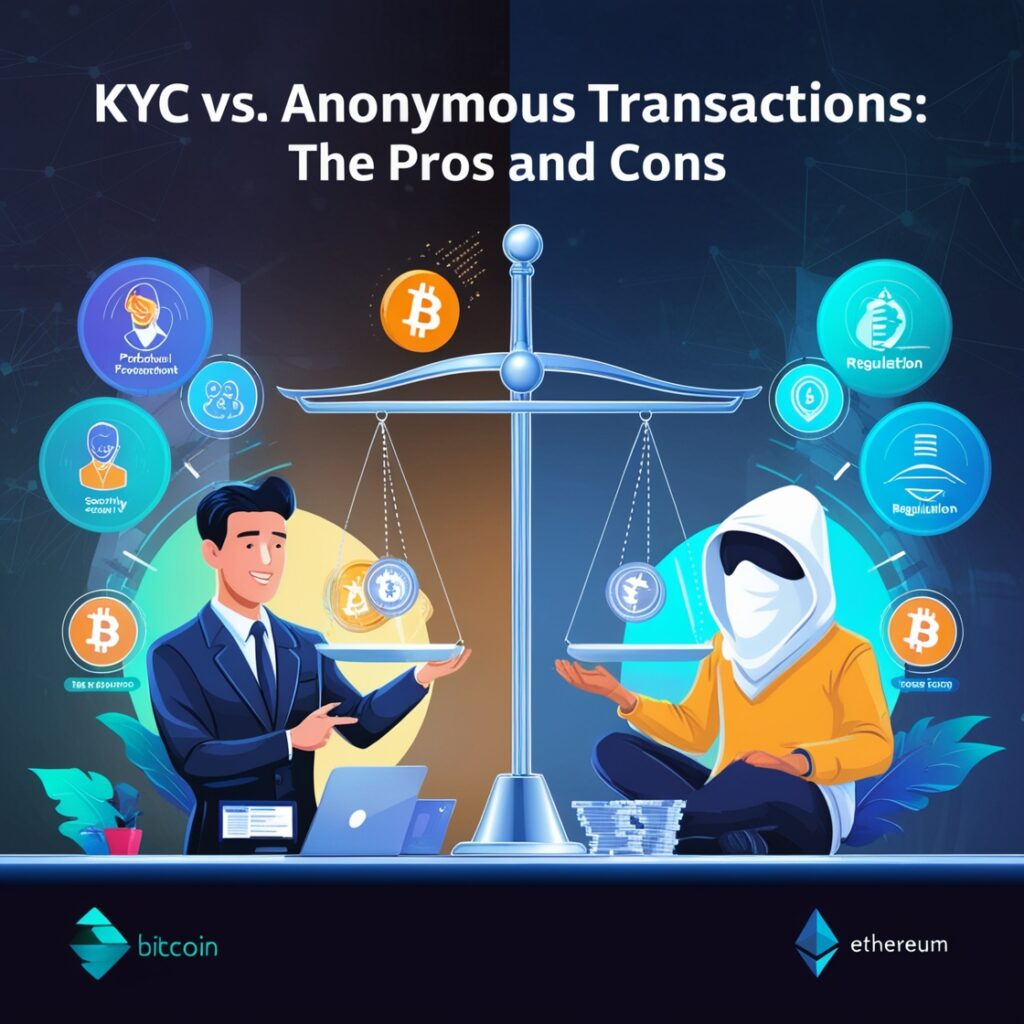
KYC: The Good and the Bad
Advantages of KYC:
- Increases security and trust in exchanges
- Helps fight crime and fraud
- Makes it easier to recover lost accounts
Disadvantages of KYC:
- Reduces privacy and anonymity
- Puts personal data at risk of hacks
- Excludes users from countries with limited access to IDs
Anonymous Transactions: The Good and the Bad
Advantages of Anonymous Transactions:
- Provides financial privacy
- Allows access to crypto for unbanked individuals
- Prevents government overreach in financial matters
Disadvantages of Anonymous Transactions:
- Can be used for illegal activities
- Harder to track stolen funds
- Some businesses and governments may ban privacy coins
Real-Life Examples: How KYC and Anonymous Crypto Are Used
Example 1: Coinbase vs. Monero
Coinbase is a well-known exchange that requires full KYC verification. While this makes it safer for users, it also means all transactions are tied to identities.
Monero, on the other hand, allows completely anonymous transactions. This makes it impossible to track who is sending or receiving money.
The Trade-Off: If you use Coinbase, you get security but no privacy. If you use Monero, you get privacy but may struggle to use it on major exchanges.
Example 2: Binance’s Struggle with KYC Rules
In 2021, Binance had to increase its KYC requirements after facing pressure from governments. Before this, users could trade without full verification, but now, most features require KYC. This shows how regulations are tightening worldwide.
The Future: Can We Find a Balance?
Many believe the best solution is a middle ground – where users get privacy but also follow basic regulations. Some possible solutions include:
- Decentralized KYC: Instead of giving your data to a single company, blockchain technology could allow secure identity verification without leaking personal info.
- Selective Privacy Coins: Cryptocurrencies like Zcash let users choose whether to make transactions public or private.
- Regulated Privacy Wallets: Some wallets may allow privacy while still following legal guidelines.
Conclusion: What Should You Choose?
Both KYC and anonymous transactions have their place in crypto. If you value security and legal compliance, using platforms with KYC might be best. If you prioritize financial privacy, privacy-focused coins and wallets could be your choice.